Michael Colbach and his team represented me after I was struck by a car while crossing on a crosswalk. -->More
 Kami Toufar

Review On Google

If you or a loved one has been injured while walking in Oregon, contact me for a free no obligation consultation as soon as you are able. In a few minutes over the phone I can usually give you an estimate of what your claim is worth so you don't get ripped off by the insurance company. If they give you an offer and you later hire me, I will not charge you a fee unless I can increase the amount that goes into your pocket.
You need to know what insurance coverage is in place to cover your medical expenses and lost wages as soon as possible. In an ideal world, I'd hope that you call me immediately, and not give the driver's insurance company any statement until you have consulted with a lawyer.
Time is of the essence, the earlier you retain an attorney means that I can do more to help you. I can deploy my investigator to the crash site, preserve evidence, and locate any witnesses. Evidence from the crash site will quickly change with time, and finding any witnesses will get more challenging.
Once I take your case, you can stop worrying about dealing with the insurance companies. I take care of all of the paperwork, phone calls, and negotiations, so you can focus on your recovery.
In Oregon, you usually have 2 years from the date of the accident to file a personal injury lawsuit, 3 years in wrongful death cases. If an Oregon public employee or Oregon government entity is at fault in your pedestrian accident, a Tort Claims Notice must be filed within 180 days, or 1 year for wrongful death.
Michael Colbach and his team represented me after I was struck by a car while crossing on a crosswalk. -->More
Kami Toufar 
Michael A. Colbach
Portland Personal Injury Attorney
BBB (Better Business Bureau) A+ Accredited Business since 2003


Your Oregon auto insurance personal injury protection coverage is no-fault medical coverage which means that even if the accident was your fault, the auto insurance personal injury protection will still have to pay. If you don't have Oregon auto insurance, nor healthcare insurance, than the at-fault driver's auto insurance policy Oregon personal injury protection (PIP) should provide you coverage up to their PIP coverage limits which in Oregon are a minimum of $15,000.
I can not emphasize enough how helpful and happy I am with what Michael and his staff did for me after I was struck by a van while crossing the street. -->More
Cory Hanson 

"Crosswalk" means any portion of a roadway at an intersection or elsewhere that is distinctly indicated for pedestrian crossing by lines or other markings on the surface of the roadway that conform in design to the standards established for crosswalks under ORS 810.200 (Uniform standards for traffic control devices). Whenever marked crosswalks have been indicated, such crosswalks and no other shall be deemed lawful across such roadway at that intersection. Where no marked crosswalk exists, a crosswalk is that portion of the roadway described in the following: (1) Where sidewalks, shoulders or a combination thereof exists, a crosswalk is the portion of a roadway at an intersection, not more than 20 feet in width as measured from the prolongation of the lateral line of the roadway toward the prolongation of the adjacent property line, that is included within: (a) The connections of the lateral lines of the sidewalks, shoulders or a combination thereof on opposite sides of the street or highway measured from the curbs or, in the absence of curbs, from the edges of the traveled roadway; or (b) The prolongation of the lateral lines of a sidewalk, shoulder or both, to the sidewalk or shoulder on the opposite side of the street, if the prolongation would meet such sidewalk or shoulder. (2) If there is neither sidewalk nor shoulder, a crosswalk is the portion of the roadway at an intersection, measuring not less than six feet in width, that would be included within the prolongation of the lateral lines of the sidewalk, shoulder or both on the opposite side of the street or highway if there were a sidewalk.
What this means is that even though there may not be a painted crosswalk, if there is a stop sign, the law probably considers there to be an implied crosswalk at the corner. Crosswalks can also really vary, 20 feet wide, but not less than 6 feet. This crosswalk legal definition can get very complicated with insurance claims. Pedestrians who are not in crosswalks are frequently dubbed negligent within these definitions of a crosswalk by insurers. This is a situation where an experienced Oregon pedestrian injury attorney can help protect your rights and if you or a loved one is seriously injured, the insurance company has every incentive to fight paying medical expenses,lost wages, pain and suffering just as the injured have to fight for that monetary relief.
There are additional legal definitions that are complicated, for instance, "ORS 811.505 Failure to stop when emerging from alley, driveway or building." This kind of traffic pattern is very familiar but also not familiar, this is a dangerous transition area for a pedestrian, and we navigate these all the time without realizing these specific nuances of transportation laws. In Portland for instance, a vehicle exiting a downtown parking garage might exit the toll area and proceed down the driveway to the edge of the parallel parked cars to have a view of approaching traffic without stopping first before crossing over the sidewalk, then proceeding.
ORS 811.505 continues: A person commits the offense of failure to stop when emerging from an alley, driveway or building if the person is operating a vehicle that is emerging from an alley, building, private road or driveway in a business or residence district and the person does not stop the vehicle as follows: (a) If there is a sidewalk or sidewalk area, the person must stop the vehicle before driving onto the sidewalk or sidewalk area. (b) If there is no sidewalk or sidewalk area, the person must stop at the point nearest the roadway to be entered where the driver has a view of approaching traffic. (2) The offense described in this section, failure to stop when emerging from an alley, driveway or building, is a Class B traffic violation.
He really is a specialist in bike law and pedestrian law too. My mom was hit by a car and his staff along with him took care of it leaving our family to concentrate on having my mom heal. I can't thank his staff and him enough. On top of that, he got a very nice settlement too. His negotiating skills are top notch!
Luck had it, I got into a bike accident myself. Who came to my rescue? This law firm. I got to see him and his staff do the magic again and also get a fantastic settlement! -->More
Elsa H Some roads in Oregon and in the Portland Metro are known to be dangerous.
Oregon Department of Transportation (ODOT) maintains a Safety Priority Index System (SPIS) which identifies high priority and dangerous roads and intersections. Oregon ODOT SPIS Brochure (PDF):
The SPIS score is based on three years of crash data and considers crash frequency, crash rate, and crash severity.
A highway segment becomes a SPIS site
if a location has:
1) three or more crashes OR;
2) one or more fatal crashes, over
the three-year period. ODOT screens these SPIS segments annually to identify and
prioritize which have potential for safety improvements and merit further investigation.
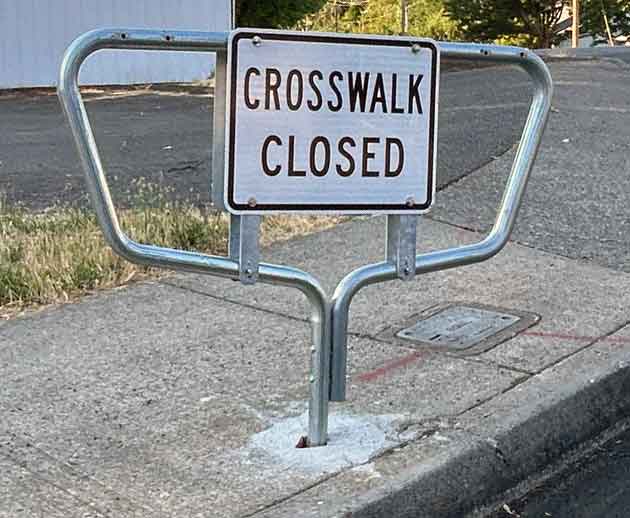
Marking a crosswalk as closed isn't a quick-and-easy decision, and it is only done when there is a safer crossing nearby.
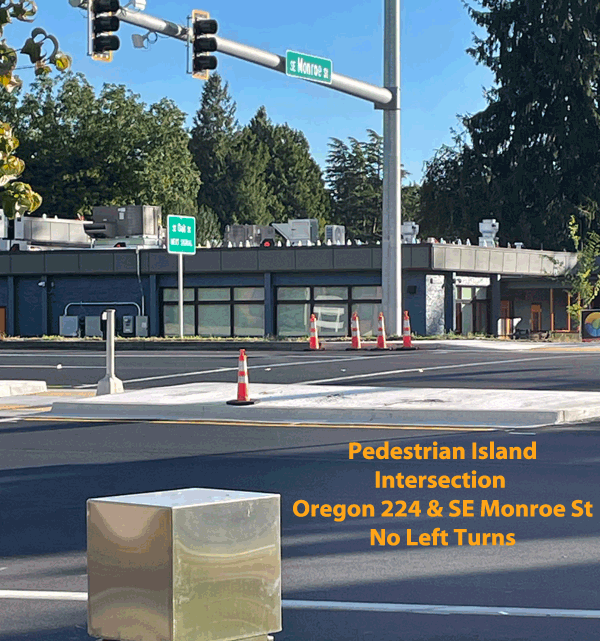
The image shows an SPIS listed intersection redesign fix newly constructed on Oregon Route 224 at SE Monroe Street.
The fix improvement closed left turns from SE Monroe onto Oregon highway 224 the Milwaukie Expressway.
The physical infrastructure in the middle of the highway not only blocks left turns by motor vehicles going through the crosswalk, it creates a safety zone for pedestrians crossing. The road is quite wide here which makes crossing it a bit more dangerous for pedestrians, cyclists, anyone outside of a motor vehicle.
The middle cement infrastructure is called a pedestrian island which helps pedestrians, cyclists, and adaptive scooters cross the wide highway with a little extra protection, and physically reinforces the right turn only for motor vehicles with the extra bollards in the middle island area.